
Journal
Stories, ideas, and field notes from T2.
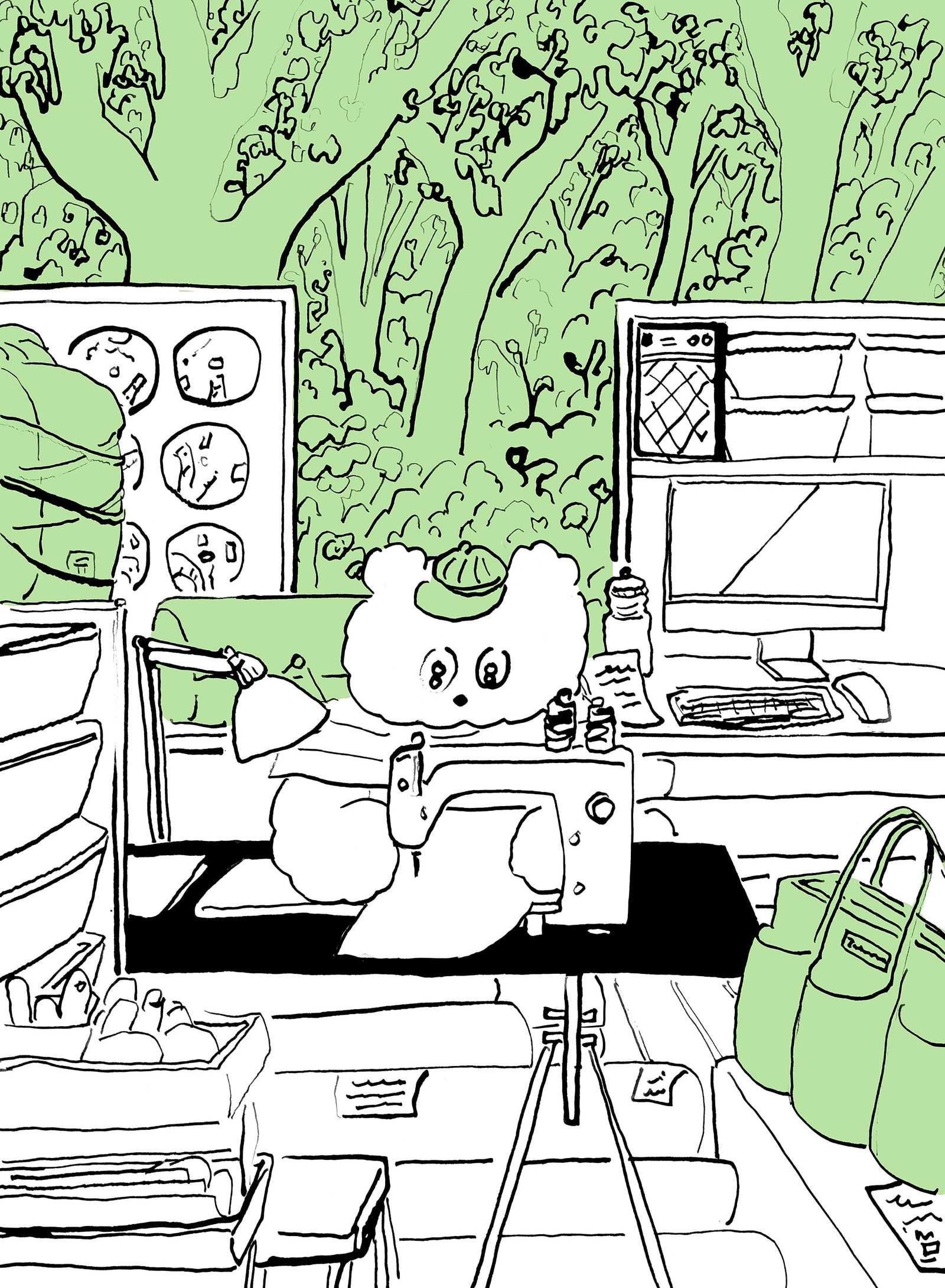

Inside the Design
— The thinking behind T2 gear
Text by Saori Hase
Illustration by Heisuke Kitazawa
Inside the Design is a serialized content series in which writer Saori Hase,
who has spent many years in the fashion industry and is also an ultrarunner,
examines Tabisuke Tabizo’s products through a design-focused perspective.
Through this series, we explore the “inside” of the design process at the Kita-Kamakura atelier
—ranging from technical development and pattern engineering aimed at achieving optimal fitting,
to the selection of materials and colors, as well as the choice of construction and sewing methods.
In Episode 1, we take a closer look at the “inside” of the new running belt,
T2 Ultra Belt, delivered across multiple installments.
Inside the Design is a serialized content series in which writer Chiori Hase, who has spent many years in the fashion industry and is also an ultrarunner, examines Tabisuke Tabizo’s products through a design-focused perspective.
Through this series, we explore the “inside” of the design process at the Kita-Kamakura atelier—ranging from technical development and pattern engineering aimed at achieving optimal fitting, to the selection of materials and colors, as well as the choice of construction and sewing methods.
In Episode 1, we take a closer look at the “inside” of the new running belt, T2 Ultra Belt, delivered across multiple installments.
Episode 1
T2 Ultra Belt
Chapter 1: Origin
True summer heat,
and a white belt
On a summer day in 2025, I was wiping sweat from my forehead as I stitched tags onto a new product, the “T2 Totebag / Mesh.”
In Kita-Kamakura, the steady sound of sewing machines filled the atelier.
Through a fortunate connection, I began helping at Tabisuke Tabizo (T2) in August.
At the time, I had only just started coming to the atelier, hoping that even my modest MYOG-level skills could be of some use.
The atelier in Kita-Kamakura is a place where each person immerses themselves in their work, while the voices of drikin and others from “backspace.fm” and the sound of sewing machines echo throughout the space—a very comfortable environment.
Suddenly, laughter and lively conversation filled the atelier.
At the center of it all was a pure white product: a running waist belt still in development.
This story is about the birth of that new product, the “T2 Ultra Belt.”
In Kita-Kamakura, the steady sound of sewing machines filled the atelier.
Through a fortunate connection, I began helping at Tabisuke Tabizo (T2) in August.
At the time, I had only just started coming to the atelier, hoping that even my modest MYOG-level skills could be of some use.
The atelier in Kita-Kamakura is a place where each person immerses themselves in their work, while the voices of drikin and others from “backspace.fm” and the sound of sewing machines echo throughout the space—a very comfortable environment.
Suddenly, laughter and lively conversation filled the atelier.
At the center of it all was a pure white product: a running waist belt still in development.
This story is about the birth of that new product, the “T2 Ultra Belt.”
Mock-ups,
and “LAKE BIWA 100.”
“I’ll be using poles at ‘LAKE BIWA 100’ .
Where should I attach them on the pack?”
The origin of this new waist belt dates back to 2024.
This question came from Hiromi Ichimura—known as “Icchy”—who was helping with the development of the XS size of the “T2 Ultra 10” at the time.
I was shown the first mock-up of the “T2 Ultra Belt,” which had actually been used at “LAKE BIWA 100.”
(At T2, we refer to a pre-sample sample as a “mock-up.” In industrial design, this term refers to a non-functional sample used to study form.)
Holding the mock-up—navy with bordeaux accents, marked with slight signs of wear—I found myself imagining the journey it had taken.
After 41 hours, 47 minutes, and 24 seconds, the first mock-up arrived at Hira Lake House alongside Ichimura.
It then returned to the atelier, carrying with it valuable feedback gained from that long journey.
From that point, the full-scale development of the waist belt began.
Where should I attach them on the pack?”
The origin of this new waist belt dates back to 2024.
This question came from Hiromi Ichimura—known as “Icchy”—who was helping with the development of the XS size of the “T2 Ultra 10” at the time.
I was shown the first mock-up of the “T2 Ultra Belt,” which had actually been used at “LAKE BIWA 100.”
(At T2, we refer to a pre-sample sample as a “mock-up.” In industrial design, this term refers to a non-functional sample used to study form.)
Holding the mock-up—navy with bordeaux accents, marked with slight signs of wear—I found myself imagining the journey it had taken.
After 41 hours, 47 minutes, and 24 seconds, the first mock-up arrived at Hira Lake House alongside Ichimura.
It then returned to the atelier, carrying with it valuable feedback gained from that long journey.
From that point, the full-scale development of the waist belt began.

Two small runners
supporting the development.
Most hydration vests available in Japan are offered in sizes S to L, and it is rare to see XS or XL.
At 156 cm tall, it has always been difficult for me to find a vest that fits properly.
I often ended up resizing an S size myself, making size selection a constant challenge.
Sizing (grading) for hydration vests—where fit during movement is critical—is far more complex than in apparel.
And because smaller sizes are produced in limited quantities, it is clear from the market that they are not the most favorable sizes for manufacturers.
Smaller sizes must maintain the same fitting mechanisms as larger ones while also preserving capacity, which inevitably increases development difficulty.
The development of the “XS size”—something that could only be described as extremely challenging—was carried out by a two-person team: Ichimura, and another small runner, Kana Yanagimura, a T2 product advisor.
This XS size, developed by these two runners, can be considered the core of the “T2 Ultra Belt.”
In the next episode, we will look at how the “T2 Ultra Belt” took shape.
At 156 cm tall, it has always been difficult for me to find a vest that fits properly.
I often ended up resizing an S size myself, making size selection a constant challenge.
Sizing (grading) for hydration vests—where fit during movement is critical—is far more complex than in apparel.
And because smaller sizes are produced in limited quantities, it is clear from the market that they are not the most favorable sizes for manufacturers.
Smaller sizes must maintain the same fitting mechanisms as larger ones while also preserving capacity, which inevitably increases development difficulty.
The development of the “XS size”—something that could only be described as extremely challenging—was carried out by a two-person team: Ichimura, and another small runner, Kana Yanagimura, a T2 product advisor.
This XS size, developed by these two runners, can be considered the core of the “T2 Ultra Belt.”
In the next episode, we will look at how the “T2 Ultra Belt” took shape.
Saori Hase
Saori Hase, born in Kobe, Hyogo, now lives in Fujisawa, Kanagawa.
Her light footwork and curiosity, cultivated through surfing, hiking, and years as a select shop staff member, led her to trail running after relocating to the Kanto region in 2019.
That same year, she was introduced to trail running through participation in “Madarao Forest Trails,” where she became drawn to the appeal of running in the mountains.
In 2022, she left her apparel company in pursuit of a more wellness-oriented lifestyle.
After taking on “Mt. FUJI 100,” a race she had long aspired to complete at least once, she began stepping further into the world of ultra-distance running.
Guided by the motto “When in doubt, choose what feels fun,” she continues to expand her connections with communities and people, while steadily building her days at her own pace alongside her pursuit of 100-mile races.
She is also active as the second-generation host of the popular trail running podcast “Sakamichi.”
Instagram


Saori Hase
Saori Hase, born in Kobe, Hyogo, now lives in Fujisawa, Kanagawa.
Her light footwork and curiosity, cultivated through surfing, hiking, and years as a select shop staff member, led her to trail running after relocating to the Kanto region in 2019.
That same year, she was introduced to trail running through participation in “Madarao Forest Trails,” where she became drawn to the appeal of running in the mountains.
In 2022, she left her apparel company in pursuit of a more wellness-oriented lifestyle.
After taking on “Mt. FUJI 100,” a race she had long aspired to complete at least once, she began stepping further into the world of ultra-distance running.
Guided by the motto “When in doubt, choose what feels fun,” she continues to expand her connections with communities and people, while steadily building her days at her own pace alongside her pursuit of 100-mile races.
She is also active as the second-generation host of the popular trail running podcast “Sakamichi.”
Instagram
Heisuke Kitazawa
Heisuke Kitazawa, born in Yokohama, now lives in Kawasaki.
An illustrator and author, he spent 16 years living in the United States before returning to Japan, where he began his career as an illustrator.
He has created illustrations across a wide range of fields, including book covers, packaging for Western confectionery brand Francais, products for Afternoon Tea and Sanrio, and menu visuals for COCO’S.
In 2026, he received the 41st Tsubota Joji Literary Award for Unicorn Letter Story (Shueisha / Home-sha).
His other works include Shiori to Mekuri: Heisuke Kitazawa Works (PIE), Yukai Yokai Note (Shogakukan), Hige ga Nagasugiru Neko (Kodansha), and Rucola no Chiisana Sagashimono-ya-san (Hakusensha).
Instagram
Official website : www.hypehopewonderland.com


Heisuke Kitazawa
Heisuke Kitazawa, born in Yokohama, now lives in Kawasaki.
An illustrator and author, he spent 16 years living in the United States before returning to Japan, where he began his career as an illustrator.
He has created illustrations across a wide range of fields, including book covers, packaging for Western confectionery brand Francais, products for Afternoon Tea and Sanrio, and menu visuals for COCO’S.
In 2026, he received the 41st Tsubota Joji Literary Award for Unicorn Letter Story (Shueisha / Home-sha).
His other works include Shiori to Mekuri: Heisuke Kitazawa Works (PIE), Yukai Yokai Note (Shogakukan), Hige ga Nagasugiru Neko (Kodansha), and Rucola no Chiisana Sagashimono-ya-san (Hakusensha).
Instagram
Official website: www.hypehopewonderland.com